


Costières de Nîmes growers swap insecticides for insect-eaters


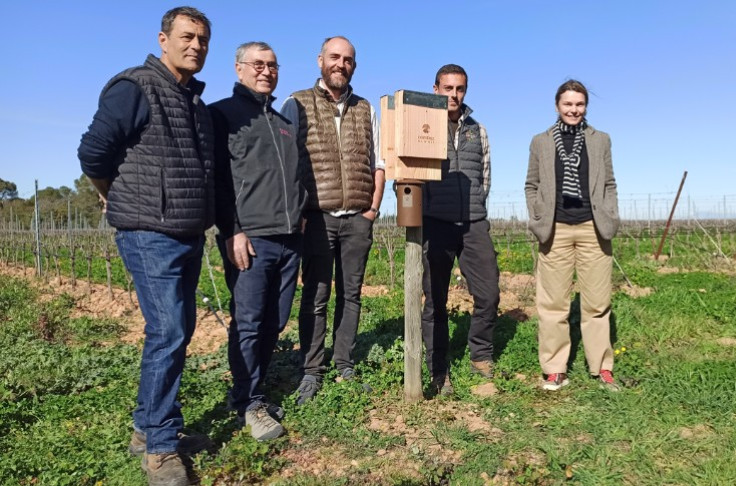
rganic winegrower Romain Teissonnière and his father Georges, in Bellegarde located in the Gard area of southern France, will soon see the return of precious beneficial fauna to their vineyards.
On 15 March, the manager of Agrinichoirs, Brice le Maire, installed 10 nesting boxes for blue tits and great tits and 10 roosts for pipistrellus bats. The nesting boxes were fixed to stakes in the middle of the vineyards, whilst the roosts were attached to posts on the edge of plots of land covering just over a hectare.
“The initiative by the growers’ organisation helps us do a little more for biodiversity”, claims Romain Teissonnière, who already sows cover crops, favours animal grazing to reduce the amount of tillage, uses mating disruption, and has just planted hedges and a thousand trees.
Fourteen other winegrowers in the Costières de Nîmes appellation area are benefiting from the scheme. “We have raised €9,000 with the support of the Water Agency. This is enough to fund up to 80% of the 300 nesting boxes”, explains Aurélie Pujol, director of the appellation board, whose objective is twofold: “To show that winegrowers can have a positive impact on the environment, and to ensure that the environment returns the favour”.
“Each summer’s night, a bat can eat almost a kilo of butterflies, such as grapevine moths. Between April and July, pairs of chickadees bring back 18,000 insects to their nest. That’s important when you consider they can make three nests a year, and that they do not stray more than 100 metres from the nest”, explains Brice le Maire.


 Facebook
 Twitter
 LinkedIn