


Using Bacillus thuringiensis to combat cryptoblabes in organic vineyards


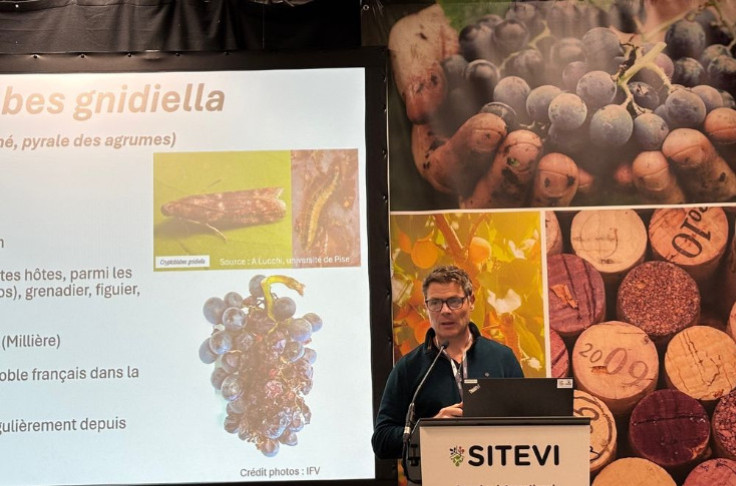
ryptoblabes gnidiella, also known as the honeydew moth, is an insect that makes winegrowers come out in a cold sweat such is the devastation it can cause in the run-up to the harvest. Organic winegrowers can use Bacillus thuringiensis-based products to combat the pest. In 2024, the French Vine & Wine Institute (IFV) assessed the performance of two products which differ in their active ingredient concentration. The first (BT1) is made with Bacillus thuringiensis ssp kurstaki SA 11 (2,4E10 UI), and the second with Bacillus thuringiensis ssp kurstaki ABTS 351 (3,2E10 UI). The researchers compared three methods: BT1 on its own; BT1 combined with an additive made from ethoxylated soybean oil; and BT2 on its own.
For each protocol, they carried out four applications on the following dates – 2, 15 and 29 July and 13 August. Each treatment was applied after 7pm. Counts conducted on 4 September showed that BTs can provide effective control of cryptoblabes. In the control example, 64% of clusters were infested compared with 23% for the BT1 protocol, 16% with the BT1 + additive method and 14% for the BT2 protocol. On average, researchers observed 3.2 larvae per cluster in the untreated control compared with 0.93 in BT1 (71% efficacy) and 0.2 for the BT1 + additive and BT2 protocols (94% efficacy).
While the results show that a 100% Bacillus thuringiensis strategy can effectively control cryptoblabes, they also demonstrate that the BT2 product is more effective than the BT1. However, adding an additive to BT1 enhances its efficacy, bringing it up to the same level as BT2. The researchers are continuing their work to hone treatment management strategies so that application timing can be optimised and the number of treatments reduced.





 Facebook
 Twitter
 LinkedIn